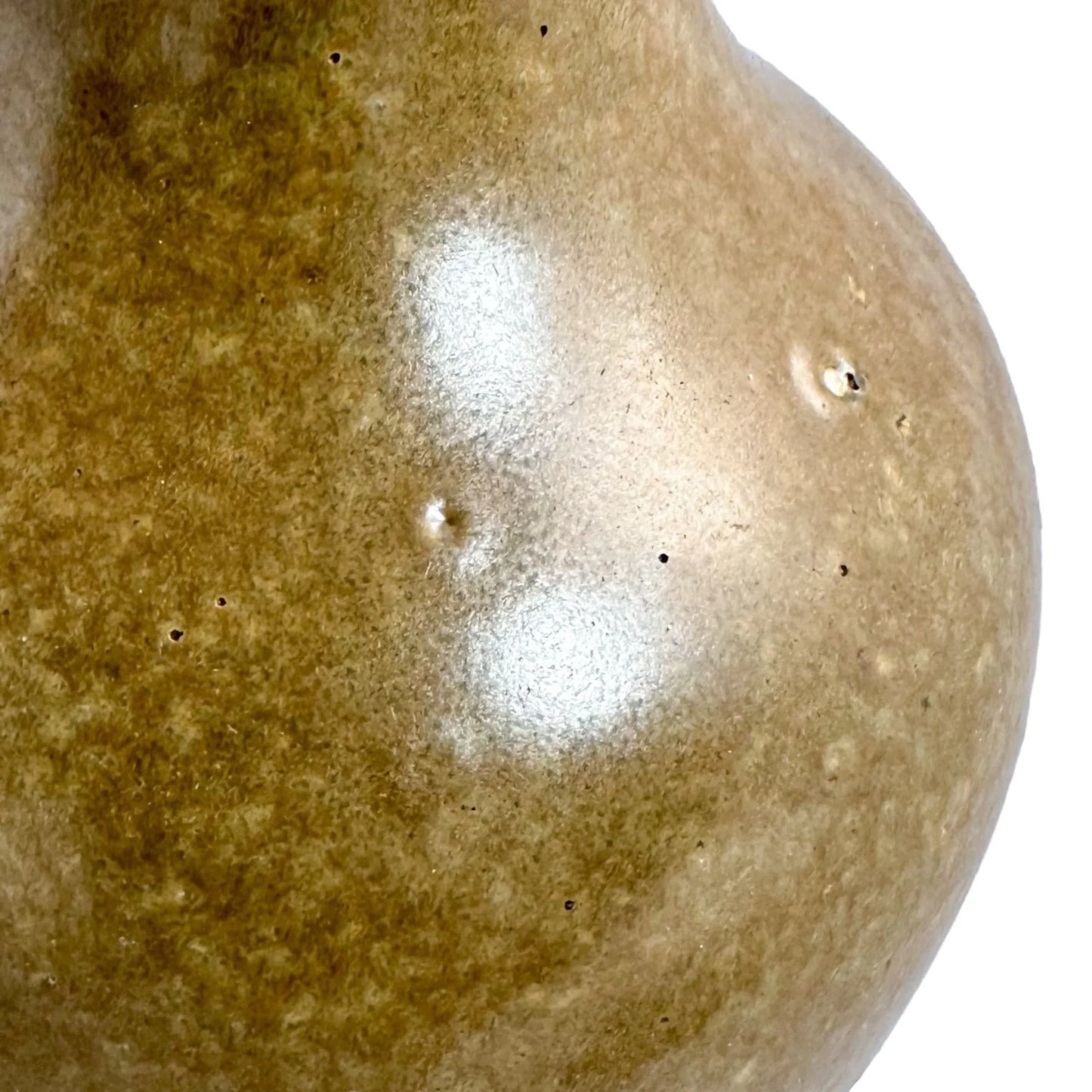
Tea dust glaze is one of those Chinese ceramic effects that sounds like a happy accident and is, in fact, a controlled one — an iron-rich glaze cooled slowly enough that iron particles migrate and pool on the surface as it sets, producing a mottled, olive-brown speckling that's genuinely difficult to fake or rush. This bottle vase, with its tall neck rising from a globular body on a short foot, carries that glaze in full effect, the surface reading as yellowish-brown at a glance and resolving into a fine green-flecked texture the closer you look.
The technique itself has real pedigree, first appearing at kilns in Shaanxi and Henan during the Tang dynasty and continuing through Ming and provincial Qing production before being deliberately revived at the imperial kilns in Jingdezhen during the Yongzheng period, where potters pushed it further as a porcelain answer to the colour and texture of aged bronze. It's a reminder that "imitation" in Chinese ceramics was rarely about cutting corners — copying bronze in clay took just as much skill as the original casting, arguably more patience.