Christopher Pinchbeck, a clockmaker rather than a jeweller by trade, developed his copper-zinc alloy in the early 1700s as a straightforward solution to a genuine problem: 18ct gold was, at the time, the only gold alloy permitted by law, and plenty of people who wanted the look of it simply couldn't afford the real thing. His invention wasn't conceived as a deception — quite the opposite, it gave buyers an honest, lower-cost alternative right up until the law changed in 1854 and lower-purity gold finally became legal to produce. There was a practical safety benefit too: pinchbeck jewellery was worth far less than gold, which made it the sensible choice for travelling, when losing a piece to theft was a real risk.
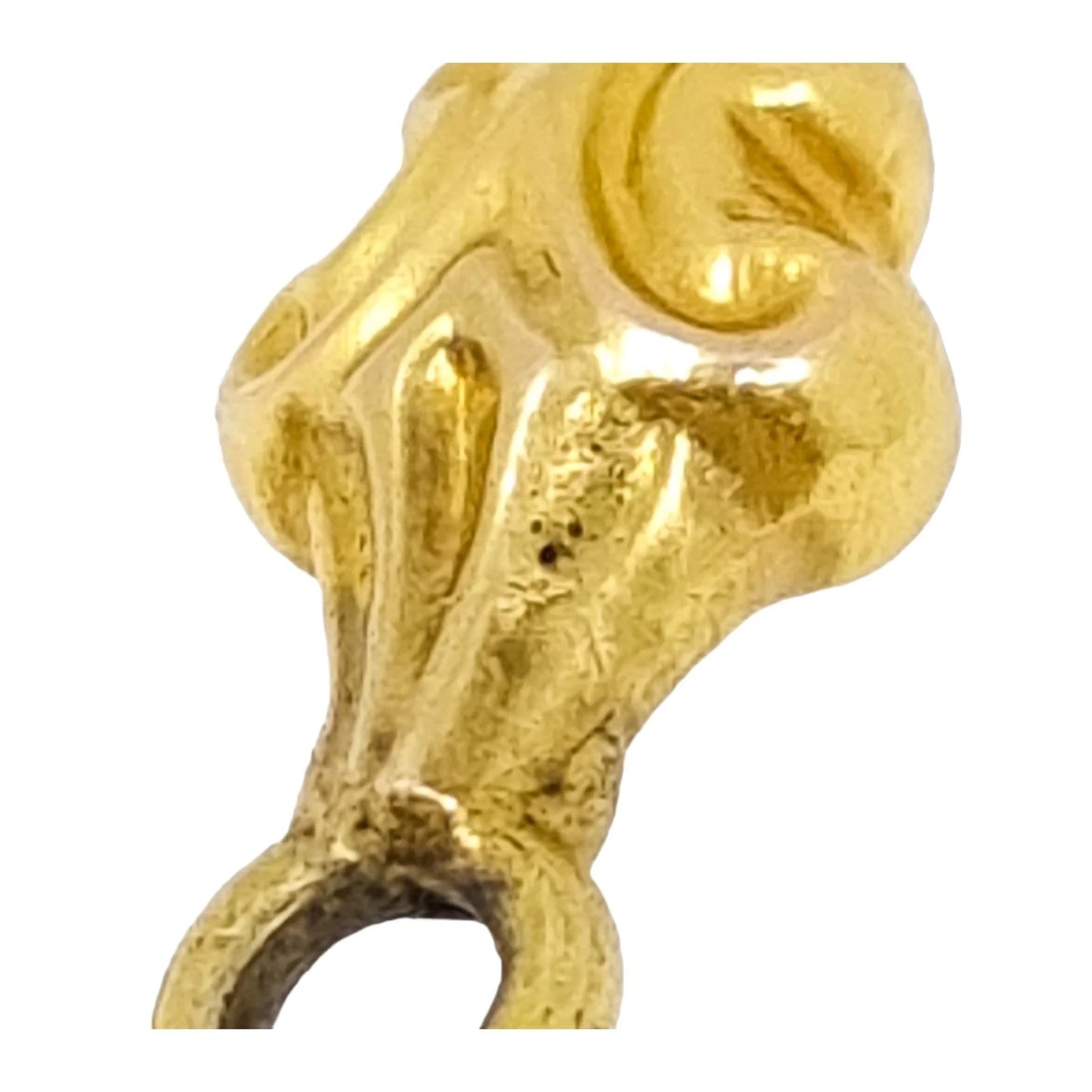
That reputation didn't survive entirely intact, unfortunately — enough people tried passing pinchbeck off as solid gold in the years after its invention that the material picked up a slightly dubious name for itself, guilt by association rather than any fault of its own. Genuine early pieces, particularly from the Georgian period when Pinchbeck's alloy was still relatively new, are now collected in their own right rather than dismissed as gold's poor relation. This example began life as a single earring in the classic Georgian torpedo form, later converted into a pendant with a 20th century bale, its openwork body decorated with embossed scrolls and leaves on one face and fine cannetille flowerwork — coiled gold wire built up into blooms — on the other.
Condition notes
Soldering just above the large filigree flower and to base of pendant. Several small holes, one side slightly pushed in.