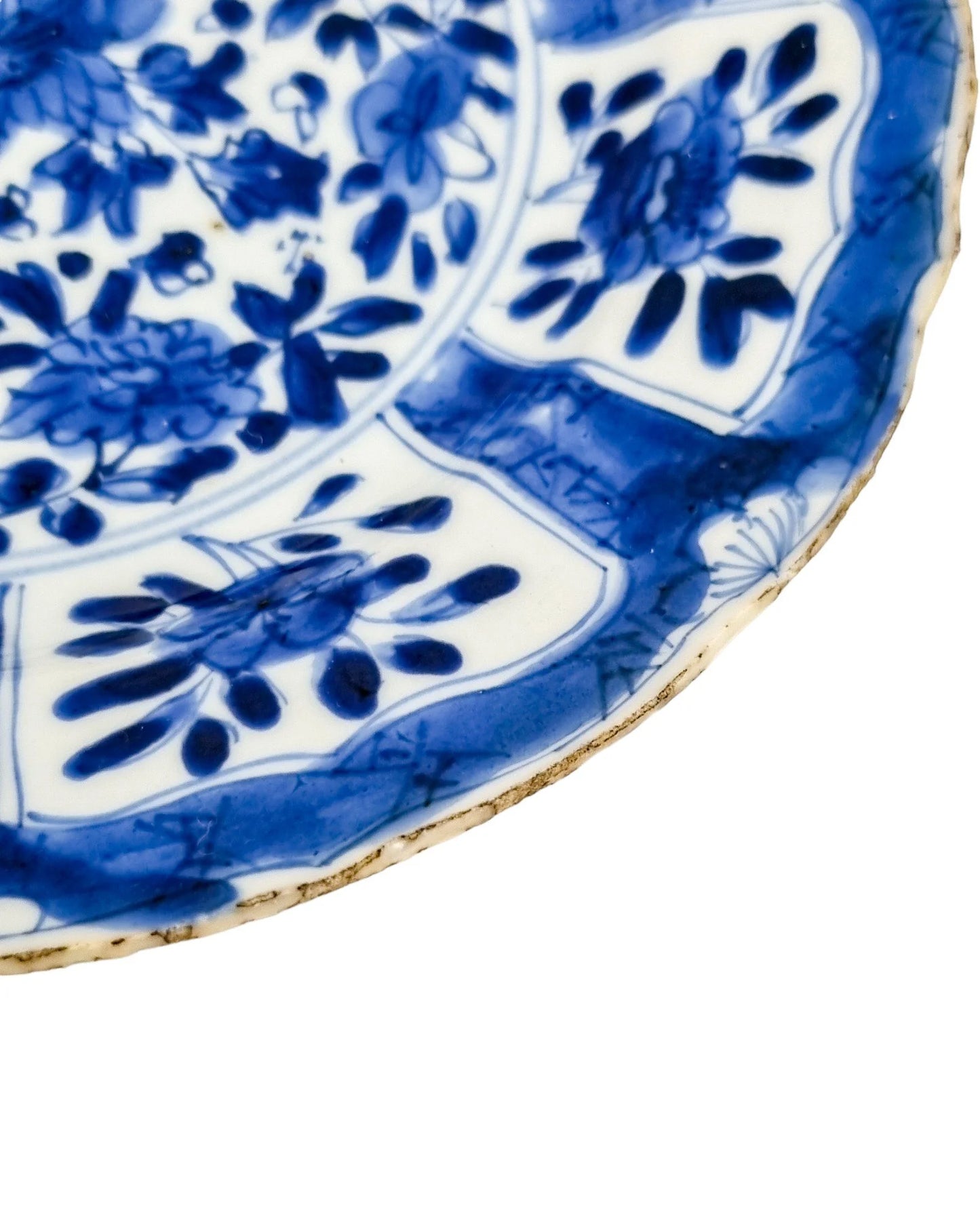
By the 1670's and 80's, Chinese potters at Jingdezhen were producing porcelain for a market that had grown considerably more demanding than it had been a century earlier — Kraak wares, developed under the Ming Wanli emperor for export via Portuguese and later Dutch traders, had already trained European buyers to expect fine white bodies divided into decorative panels, and Kangxi-period potters inherited and refined that formula rather than abandoning it. This plate carries that legacy directly: floral motifs set within cartouches, painted in a cobalt blue that's had three centuries to settle into the glaze, on a body thin enough to hold light at the rim.
The Artemisia leaf mark on the base is one of a handful of symbolic marks Kangxi-period potters used in place of a reign mark, likely to avoid the awkwardness of an inferior piece bearing the emperor's actual name — a workaround more common than you might expect on porcelain of this period, and a useful dating clue in its own right. Dating to roughly 1670-1690, within the long Kangxi reign, the plate sits at a point when Chinese export porcelain was arguably at its technical peak, palace politics and trade routes aside.
Condition notes
Few firing pockmarks to glaze; wear to glaze and small nibbles all along the rim; repair along the edge of the plate.