Gustavian style takes its name from Sweden's King Gustav III, whose reign through the 1770's, 80's, and into the 90's brought French neoclassical taste north and filtered it through a distinctly Nordic restraint: less gilt, more discipline, geometry favoured over florid ornament. This box wears that restraint well. Solid Honduras mahogany runs through the whole thing, interior and underside included, with three diamond-shaped inlays, known as romber, set into the lid in pale satinwood or pearwood against the dark ground, bold in scale but kept firmly in line by the symmetry around them.
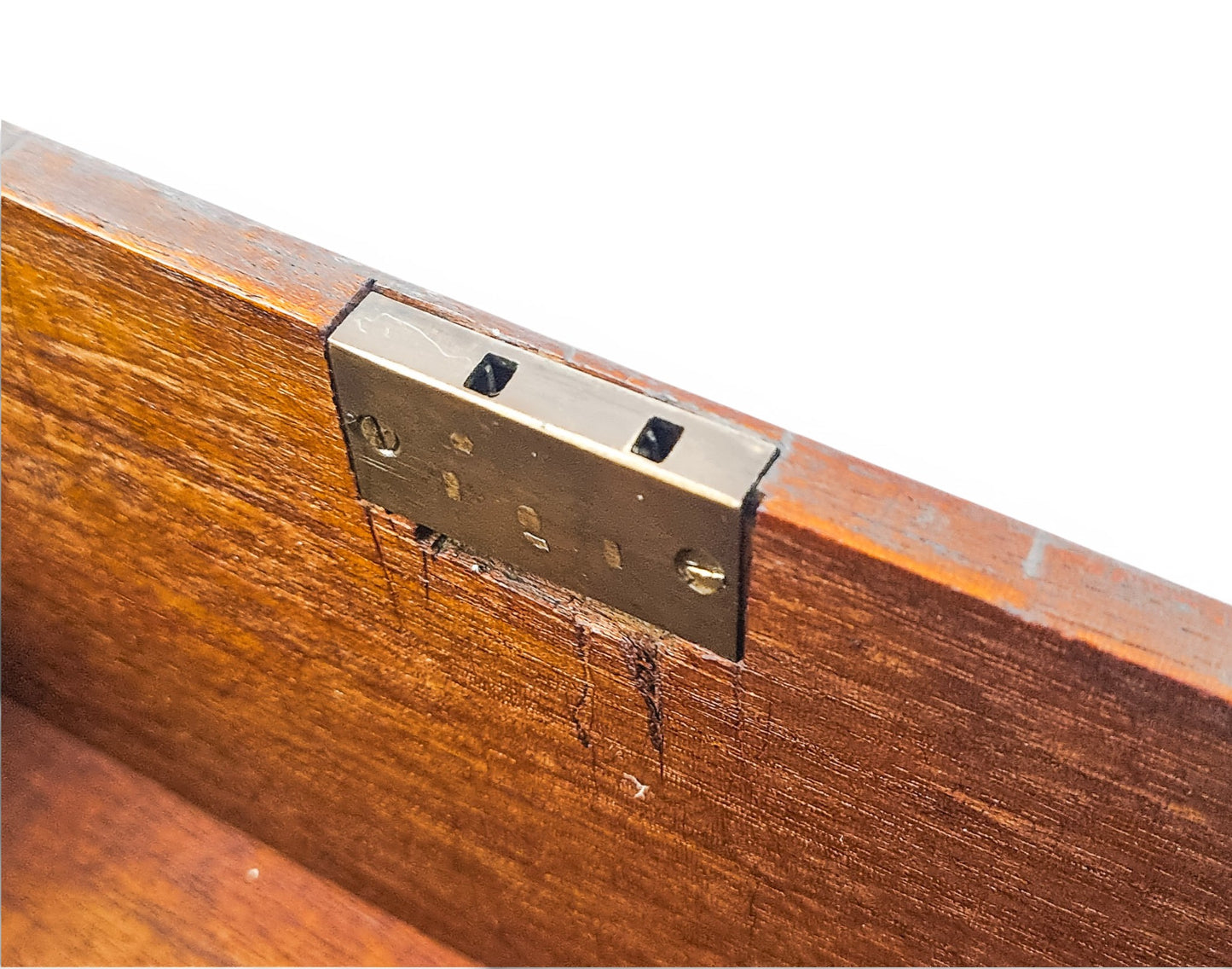
The construction matches that same restraint. Mitred corners hide the end grain around the exterior, and the interior still carries faint hand-scribed construction lines and marking-gauge marks, the kind of evidence bench-made work leaves behind and later restoration usually scrubs away without meaning to. At 30.5 cm long, this is a proper tabletop box rather than a small jewellery casket, likely built for documents or correspondence, with one open compartment inside rather than anything divided up. The original brass lock sits flush and hand-mortised into the front rim, paired with hand-slotted offset screws and a keyhole cut straight through the mahogany, exactly the sort of pre-industrial detail that gives the game away: this was made by hand, not off a production line.
Condition notes
Excellent antique condition with a naturally developed patina. There are scattered small nibbles, knocks, scratches and surface marks consistent with more than two centuries of age and use. The contrasting diamond inlays display some age-related shrinkage and fine hairline cracking. The lid closes securely, although it needs to be pushed slightly forward when closing so that the catch aligns correctly with and enters the lock.